
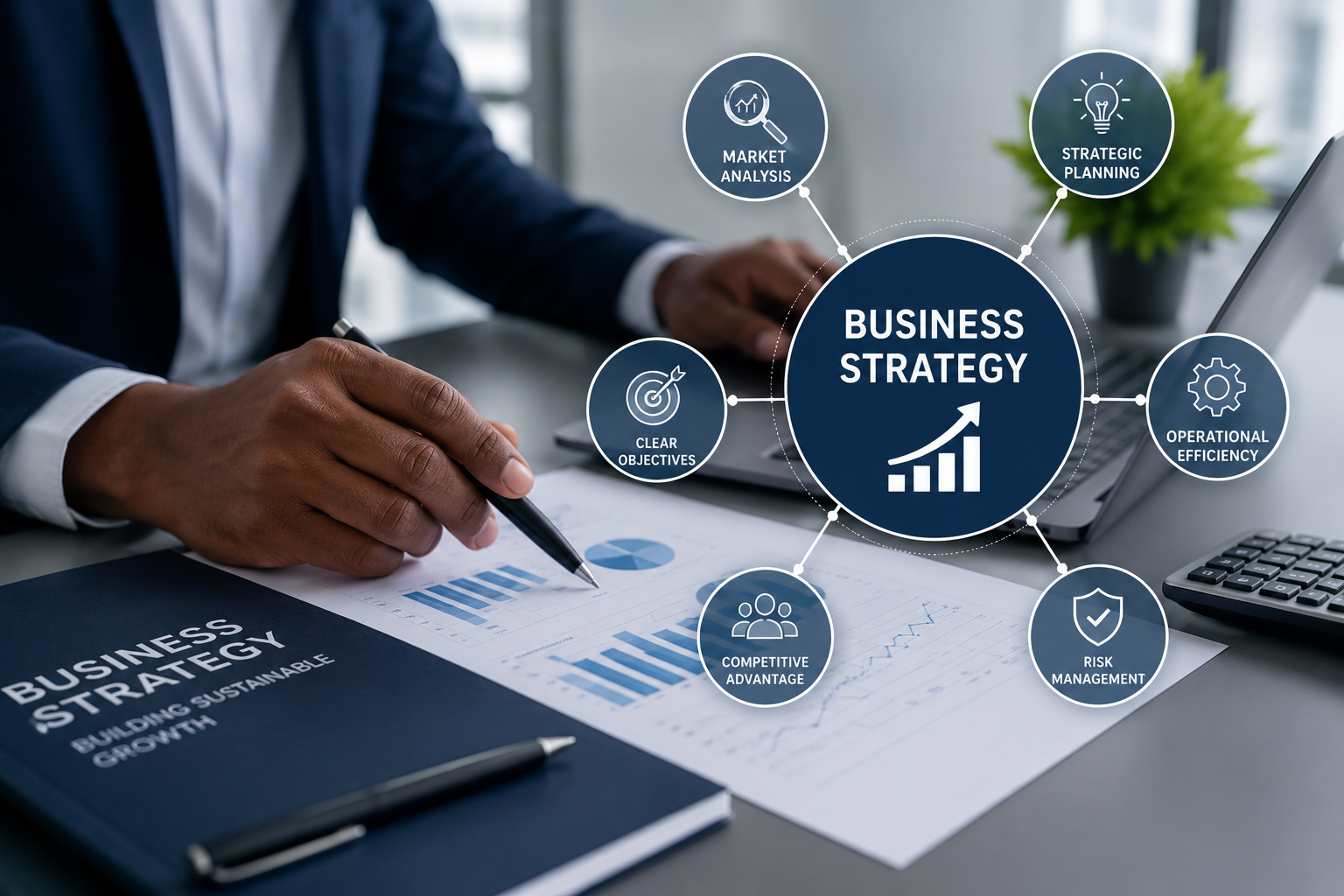
Business strategy is the structured process through which an organisation determines where it wants to go, how it intends to compete, how resources should be allocated and what actions are required to achieve sustainable commercial objectives.
For businesses operating in Kenya, effective strategy extends beyond preparing a business plan. It requires management to understand the organisation's financial position, customers, competitors, operational capabilities, tax environment, risks and opportunities before making significant decisions.
A strong business strategy should therefore answer several important questions:
Where is the business today? Where does management want the business to be in the next three to five years? Which customers and markets should the business prioritise? Which products or services generate the greatest value? What financial resources will be required? Which operational weaknesses could restrict growth? What risks could affect the organisation's objectives? How should management measure whether the strategy is succeeding?
At Actuarialens Limited, we believe that better business decisions begin with a clearer understanding of the numbers, opportunities and risks that shape an organisation.
Why Business Strategy Matters for Companies in Kenya
Kenyan businesses operate within a dynamic commercial environment. Changes in customer behaviour, financing costs, taxation, technology, regulation, competition, exchange rates and operating expenses can materially affect business performance.
An organisation may generate increasing revenue while simultaneously experiencing declining margins or deteriorating cash flow. Another business may have strong demand but lack the systems, capital or operational capacity required to scale sustainably.
This is why strategic planning should connect financial analysis, taxation, business operations, risk management and commercial objectives.
Management should not consider these areas independently.
For example, opening a new branch may initially appear to be a sales and expansion decision. However, the decision may also involve capital expenditure, staffing costs, working-capital requirements, taxation, insurance, financing, supply-chain considerations and operational risk.
A well-developed business strategy examines the complete commercial picture before significant resources are committed.
Common Strategic Challenges Facing Kenyan Businesses
Businesses encounter different challenges depending on their industry, size and stage of development. However, several strategic issues frequently require management attention.
1. Cash Flow and Working Capital Pressure
Profit and cash are not the same thing.
A profitable company can still experience financial difficulty where customers take too long to pay, inventory levels become excessive or suppliers require payment before the business collects revenue.
Effective cash-flow forecasting and working-capital management can help management anticipate potential shortages and make financing or operational decisions before liquidity becomes critical.
2. Rising Operating Costs
Payroll, utilities, transport, financing, technology, imported inputs and other business expenses can place pressure on margins.
Management should regularly examine:
gross margins, operating expenses, supplier costs, pricing, productivity, financing costs, and profitability by product, service, branch or customer segment.
Strategic cost management is not simply about reducing expenditure. The objective should be to determine which costs create value and which costs reduce performance without producing sufficient commercial benefit.
3. Expansion Without Adequate Planning
Growth can create opportunities, but poorly planned growth can also create financial strain.
Before opening additional branches, entering new markets, introducing products or making major investments, businesses should consider conducting appropriate financial modelling, feasibility analysis and scenario planning.
Management should understand not only the expected return but also what happens if revenue is lower than anticipated, costs increase or implementation takes longer than expected.
4. Weak Management Information
Business decisions become difficult when management does not have reliable information.
Companies may have accounting records but still lack useful management information concerning:
profitability, cash flow, budgets, customer performance, cost trends, operational efficiency, and key business risks.
Management accounts, dashboards and appropriately selected key performance indicators (KPIs) can help transform accounting information into practical decision-making intelligence.
5. Strategy That Is Not Connected to Financial Reality
A business may have ambitious growth objectives without understanding the financial resources required to achieve them.
Strategic plans should therefore be supported by realistic:
budgets, revenue forecasts, cash-flow forecasts, capital requirements, financing assumptions, and sensitivity analysis.
This allows management to determine whether the proposed strategy is financially sustainable.
The Business Strategic Planning Process
An effective strategic planning process should move from understanding the current business position toward defining measurable actions.
1. Understand the Current Position
Management should begin with an objective assessment of the organisation.
This may include reviewing financial performance, customers, competitors, products and services, operational processes, employees, technology, taxation, financing and risk.
The purpose is to establish a realistic starting point.
2. Define Strategic Objectives
The organisation should determine what it intends to accomplish.
Objectives could include:
increasing profitability, improving cash flow, entering a new market, expanding geographically, improving operational efficiency, introducing new products, strengthening financial controls, reducing business risk, or preparing the organisation for investment.
Strategic objectives should be sufficiently specific to allow progress to be measured.
3. Evaluate Strategic Options
There is rarely only one route to growth.
Management may need to compare different scenarios before committing resources.
For example, a company seeking expansion could consider opening another physical location, strengthening its existing operation, developing digital distribution, entering into partnerships or expanding through an existing distribution network.
Financial modelling and scenario analysis can help management compare these alternatives.
4. Develop Financial Forecasts
Strategy should ultimately translate into numbers.
A strategic financial model may include projected:
Revenue → Costs → Profitability → Working Capital → Cash Flow → Capital Requirements → Financing → Return on Investment
Different assumptions can then be tested to understand how the business may perform under alternative circumstances.
Scenario Analysis: Planning Beyond the Best-Case Outcome
Business forecasts should not assume that everything will proceed exactly as planned.
Management can develop several scenarios, such as:
Base Case: The business performs broadly according to management's expectations.
Upside Case: Revenue growth, margins or operational performance exceed expectations.
Downside Case: Revenue grows more slowly, costs increase or other commercial pressures emerge.
Scenario analysis allows management to understand the potential financial consequences before making major decisions.
For Kenyan businesses facing uncertain economic and commercial conditions, this can be particularly valuable when evaluating expansion, borrowing, capital investment and long-term commitments.
Feasibility Studies Before Major Investments
A feasibility study can help determine whether a proposed business opportunity is commercially and financially viable before substantial capital is committed.
Depending on the proposed investment, analysis may consider:
market demand, competition, pricing, expected revenue, operating costs, capital expenditure, financing requirements, cash flow, break-even point, implementation requirements, taxation, regulatory considerations, and major business risks.
The objective is not to guarantee that an investment will succeed. Rather, it is to provide management with better information before resources are committed.
Business Strategy and Risk Management
Every strategy involves risk.
Expansion may introduce execution risk. Borrowing introduces financial risk. New suppliers can create supply-chain risk. Technology creates operational and cybersecurity considerations. International transactions can introduce currency and cross-border risks.
Risk management should therefore form part of the strategic planning process rather than being considered only after decisions have been made.
Management should ask:
What could prevent us from achieving this objective?
The next question should be:
What can we reasonably do to reduce, transfer, monitor or prepare for that risk?
This creates a more resilient business strategy.
Turning Strategy Into Measurable Performance
A strategy has limited value if it remains only a document.
Management should translate strategic objectives into measurable indicators.
Depending on the organisation, useful KPIs may include:
revenue growth, gross profit margin, operating margin, cash conversion, debtor days, inventory turnover, customer retention, recurring revenue, return on investment, operating costs as a percentage of revenue, and performance against budget.
Management can then periodically compare actual results against strategic targets and make adjustments where necessary.
How Actuarialens Supports Business Strategy
Actuarialens Limited supports organisations seeking a clearer understanding of their business before making important commercial decisions.
Our Business & Strategic Advisory approach brings together financial information, commercial analysis, operations and risk considerations to help management evaluate opportunities more comprehensively.
Depending on the client's circumstances, support may include:
business planning and strategic reviews, financial forecasting and budgeting, cash-flow analysis, feasibility studies, financial modelling, scenario and sensitivity analysis, management information and KPI development, process and performance reviews, business expansion analysis, decision-support analysis, and identification of financial and operational risks.
Rather than viewing strategy separately from finance and risk, Actuarialens seeks to provide management with an integrated view of the business.
Building Sustainable Business Growth in Kenya
Sustainable growth is not simply about increasing sales.
A growing organisation must also ensure that its cash flow, financial controls, operational capacity, people, technology and risk-management capabilities can support the increased scale of the business.
The strongest strategies therefore combine ambition with financial discipline.
For Kenyan companies, SMEs, family businesses, growing enterprises and established organisations, periodic strategic reviews can help management identify where the business is performing well, where value may be lost and where future opportunities may exist.
Ultimately, effective strategy is about making informed choices.
At Actuarialens, our philosophy is simple:
See the Numbers. Understand the Risk. Make Better Decisions.
Professional Disclaimer
This article is provided by Actuarialens Limited for general informational and educational purposes only. It does not constitute financial, tax, legal, investment or other regulated professional advice and should not be relied upon as a substitute for advice relating to the specific circumstances of an organisation.
Where specialist or regulated professional services are required, appropriate qualified and authorised professionals should be engaged.
Businesses seeking support with business strategy, financial modelling, feasibility studies, business planning, forecasting, performance improvement or strategic decision-making in Kenya may contact the Actuarialens team to discuss their specific requirements.